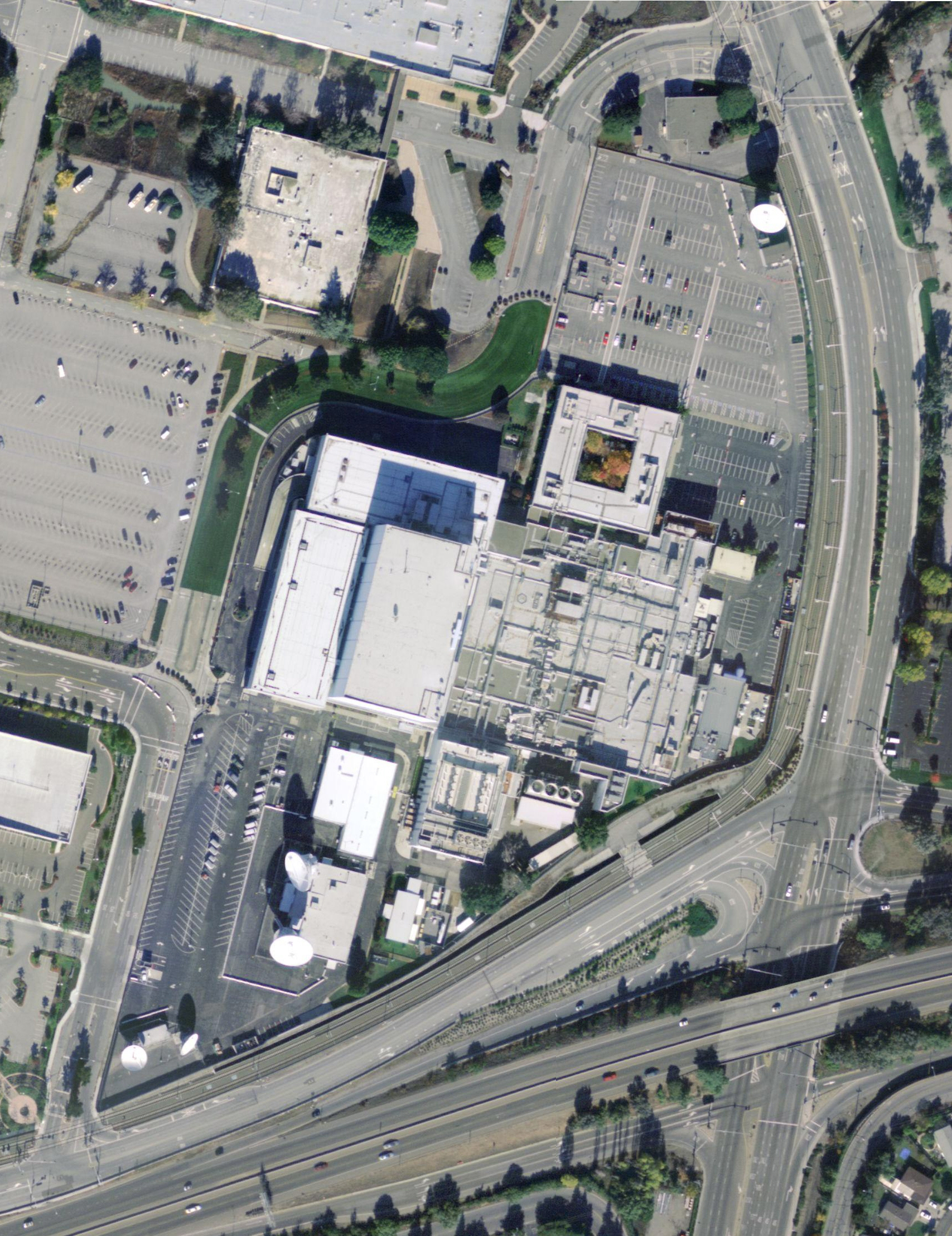
27 December 2004
Updated with higher resolution images dated 27 February 2004 from
Terraserver-USA.
Previous NRO MCC Eyeball:
http://cryptome.org/eyeball/nromf/nromf-eyeball.htm
The
Air Force Satellite Control Network is celebrating 40 years of operations
this year [1999]. AFSCN makes use of communications resources scattered
throughout the world to get information to and from every satellite the Air
Force has in the sky. Also called "The Network to the Stars," the AFSCN is
a global configuration of control nodes, communications satellites and eight
strategically located Remote Tracking Stations dedicated to supporting the
U.S. space program. Each of these components supports launch and early orbit
checkout, telemetry, tracking and commanding and data processing for the
four operational military missions of navigation, surveillance, weather and
communications. The AFSCN also supports NASA's space shuttle, ascent-only
vehicle and ballistic missile operations.
The AFSCN was formed on April 6, 1959, when the Air Force decided a unit
dedicated to providing satellite tracking support was necessary. The 6594th
Test Wing became this unit, with three operating locations at Edwards AFB,
Calif.; Chiniak, Alaska; and Annette Island, Alaska. In addition, Vandenberg
AFB, Calif.; Hawaii; and New Boston Air Station, N.H., tracking stations
joined the unit in late 1959.
The 6594th TW changed to the Satellite Test Annex in 1960 and then the Air
Force Satellite Control Facility in 1965.
With the birth of Air Force Space Command in 1982, the AFSCF inactivated
and became the 2nd Satellite Tracking Group, later renamed the 750th Space
Group. Deciding having only one satellite control node on the West Coast
was not enough, AFSPC built Falcon AFB (now Schriever) in 1985 as an alternate
control node. June 25, 1999 marked the end of an era for the AFSCN as the
50th Operations Group took responsibility for overall AFSCN operations with
the inactivation of the 750th SG.
The AFSCN's daily operations are executed by the 21st Space Operations Squadron,
Onizuka Air Station; 22nd SOPS, Schriever AFB; and 23rd SOPS, New Boston.
Made up of a team of military personnel, Department of Defense civilians
and government contractors, the AFSCN uses two communications nodes--one
at Onizuka Air Station, Calif., and one at Schriever--to allow national,
allied, civil and DoD organizations to communicate with more than 120 satellites
every day. Using any of 15 antennas distributed at eight worldwide RTS's,
the AFSCN allows the users of the Air Force's numerous satellite systems
to conduct 425-500 contacts with their satellites each day, providing crucial
information to ground and air forces.
http://www.schriever.af.mil/50sw/fact_sheets/21SOPSfs.doc
21ST SPACE OPERATIONS SQUADRON
The 21st Space Operations Squadron, a unit of the 50th Network Operations
Group, 50th Space Wing, Schriever Air Force Base, Colorado, is located at
Onizuka Air Force Station, Sunnyvale, California. The 21st Space Operations
Squadron is the host unit at OAFS.
Mission
The squadron plans and conducts specialized communications for a wide spectrum
of Department of Defense, allied, civil and commercial space systems. The
21st SOPS is a squadron that is rich in tradition. Every Space Shuttle mission
in history has been supported from Onizuka. It schedules, allocates, and
configures Air Force Satellite Control Network common user resources; monitors,
maintains and updates the status of AFSCN resources and provides status,
configurations, and readiness of controlled resources to multiple users and
command centers.
The 21st SOPS maintains the facilities necessary to support a full deployment
by 1st and 3rd SOPS, in the event of an emergency or routine relocation.
Additionally, 21st SOPS maintains a backup scheduling facility, which is
used as a backup to 22nd SOPS' facility at Schriever Air Force Base, Colorado.
It also manages communications systems for network operations and maintains
and operates base communications.
The squadron provides access to the worldwide Air Force Satellite Control
Network and specialized support to the international space community by providing
network communications. The unit is also responsible for maintaining Onizuka's
two, 60-foot, Defense Satellite Communication System antennas. The 21st SOPS
acts as the back-up for scheduling tracking station usage for satellite
operators.
As host unit for Onizuka Air Force Station, 21st SOPS provides resources
to operate and maintain the OAFS facility and to provide administrative and
support services to base units and agencies, including security, services,
civil engineering and safety.
Further, the squadron provides some base support to units on Moffett Federal
Airfield. The 21st Space Operations Squadron commander is designated the
installation commander for Onizuka Air Force Station.
History
The 21st Space Operations Squadron was established in October 1991 and consisted
of network scheduling, planners, directors and communications operations.
In 1992, 21st SOPS assumed command of the Camp Parks Communications Annex,
from 750th OSS and Inter-Range Operations from Air Force Systems Command.
21st SOPS assumed base support at OAFS with the deactivation of the 750th
Space Group June 7, 1999. On 1 October 2002, 21st SOPS transferred the Camp
Parks Communications Annex to SMC Detachment 12.
Corporations involved in MCC operations:
The Aerospace Corporation
1080 Lockheed Martin Way, Box 018
Sunnyvale, CA 94089-1232
Phone: 408.744.6484
Fax: 408.744.6668
Harris
Technical Services Corporation
1080 Lockheed Martin Way
Box 128
Sunnyvale, CA, USA, 94089
Telephone: 408-752-4698
Boeing
Mission Systems
1080 Lockheed Martin Way, Box 36
Sunnyvale, CA 94089
PHONE: 408.548.2101
FAX: 408.744.2250
Raytheon Technical Services Company
1080 Lockheed Martin Way
Sunnyvale, CA 94089
(408) 752-3607
Lockheed
Martin Space Systems Co., Sunnyvale, Calif., is being awarded a $6,638,280
firm-fixed-price contract modification to manage and perform operations,
operations support, software and database maintenance and training for the
21st Space Operations Squadron located at Onizuka Air Force Station, Calif.
Support consists of launch and early orbit operations for the Inertial Upper
Stage/Defense Support Program; data flow operations for National Aeronautics
and Space Administration satellite programs, the Space Transportation System,
boosters and other Air Force Satellite Control Network eternal users; operations
support to include satellite support planning, scheduling and reporting,
attitude and orbital analysis, and data processing; level software and level
1 database maintenance for AFSCN common user and mission unique equipment;
simulation and scenario generation for mainframe systems (i.e. Inertial Upper
Stage Flight Controller Telemetry Simulation System) to support launch rehearsal
and government training; training in support of this contract; and deployment
support. Total funds have been obligated. Solicitation began March 2002,
and negotiations were completed July 2002. The 50th Contracting Squadron
is the contracting activity (FA2550-02-C-0006).
Lockheed
Martin Missiles and Space Corp., Sunnyvale, Calif., is being awarded
a $6,206,083 modification to a cost-plus-award-fee contract,
F04701-92-C-0049-P00252, to provide for FY2000 Mission Control Segment Level
Two Software maintenance in support of the MILSATCOM communication satellite
system. Expected contract completion date is Sept. 30, 2000. Space and Missile
Systems Center, Los Angeles AFB, Calif., is the contracting activity.
From previous Eyeball:
http://cryptome.org/eyeball/nromf/nromf-eyeball.htm
24 May 2002.
Anonymous writes:
The facility is actually the Sunnyvale Control Center where NRO birds were
controlled, and there are similar facility in Pine Gap, Australia, Iceland,
Turkey, etc. But THIS is the main facility, everything else is secondary.
Once a NRO bird was launched THIS was one of major control points and tasking
for the up-link to the bird. While the bird itself was in a low altitude
flight path, communication was bounced off a high orbit satellite (or multiple
satellites) and back to ground. The control signalling and tasking
worked the opposite way. Sunnyvale itself is a perfect place for an up-link,
but a really bad place for a down-link. You need a Top Secret SI/TK clearance
to get past the front door of the building. The NRO/USAF has run a classified
school on at the facility for over 20 years, and NASA even has an office
on site so the astronauts can receive NRO "space platform" training.
A. adds:
I did some research that I should have done beforehand. It all seems to point
towards the station being related to the NRO and to the control of satellites.
The installation is in fact the 21st Space Operations Squadron (21SOPS),
located not on the grounds of Moffett Field, but on those of
Onizuka Air Force Base. In fact,
onizuka.af.mil is registered to "21SOPS/MA" at 1080 Lockheed Martin Way,
Box 45, Sunnyvale, CA 94089. A document at
http://www.losangeles.af.mil/SMC/XR/CSOS/Documents/Industry%2520Day%2520Brief.pdf
under the heading of "Satellite Control: Commercial Synergies," connects
21SOPS to satellite control and the NRO: "Range/Comm segments, 21 Satellite
Operations Squadron (SOPS), NRO Mission Control Center (MCC) operations primarily
contractor operated." I wonder what "Range" means. In case that wan't enough,
a document at
http://ax.losangeles.af.mil/axl/stab.xls
lists a "positional trainer" program for the "Distributed Communications
Controller" (DCC). The DCC, probably a satellite control system, may be the
same as the Cooperative Distributed Communications Controller (CDDC), an
"Adaptive Intelligent Agent" originally developed by Planning Research
Corporation (www.prc.com) before it was
purchased by Northrop Grumman. The systems center in charge of the training
is "SMC/CW," and the units involved include 21SOPS and NRO, as well as Remote
Ground Stations (RGS) and Satellite Operations Centers (SOCS). The web site
for SMC/CW seems to be at
http://cw.losangeles.af.mil
which says "Satellite (and Launch) Control System Program Office."
23 May 2002
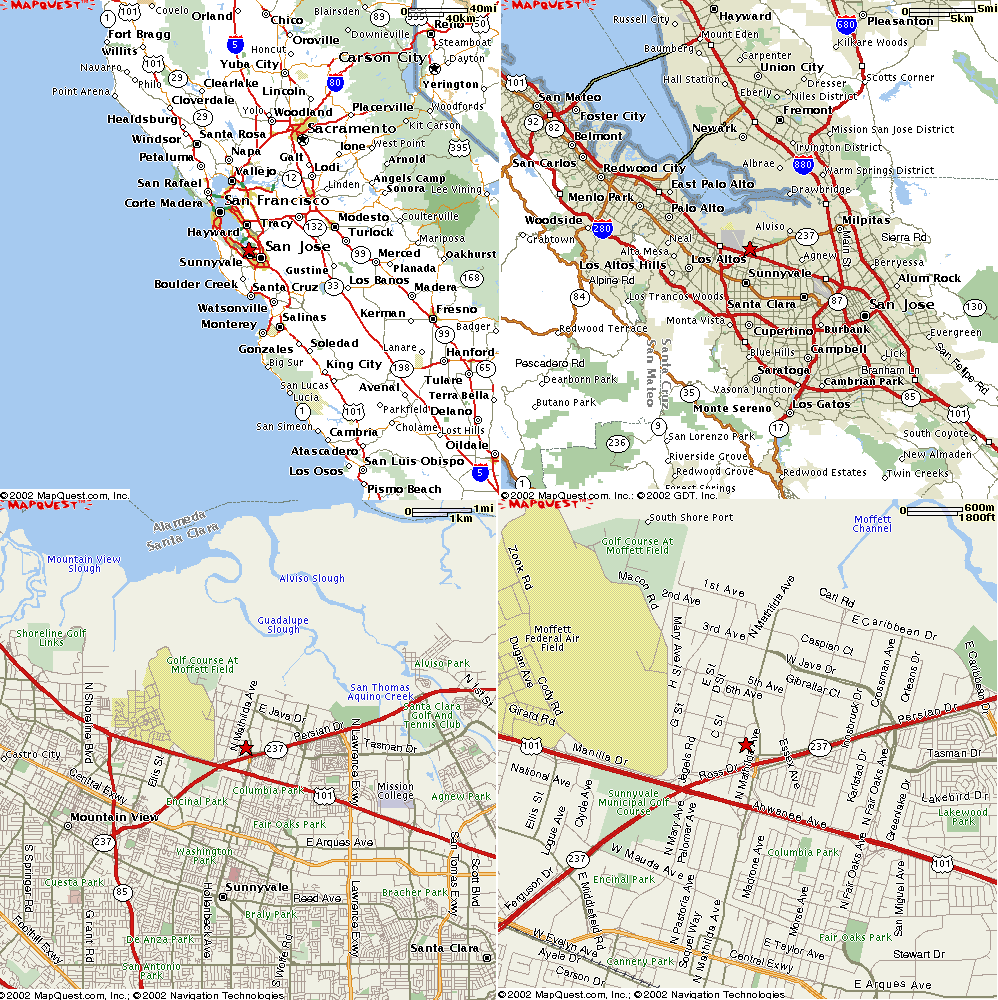
Source: Mapquest.com
A. writes:
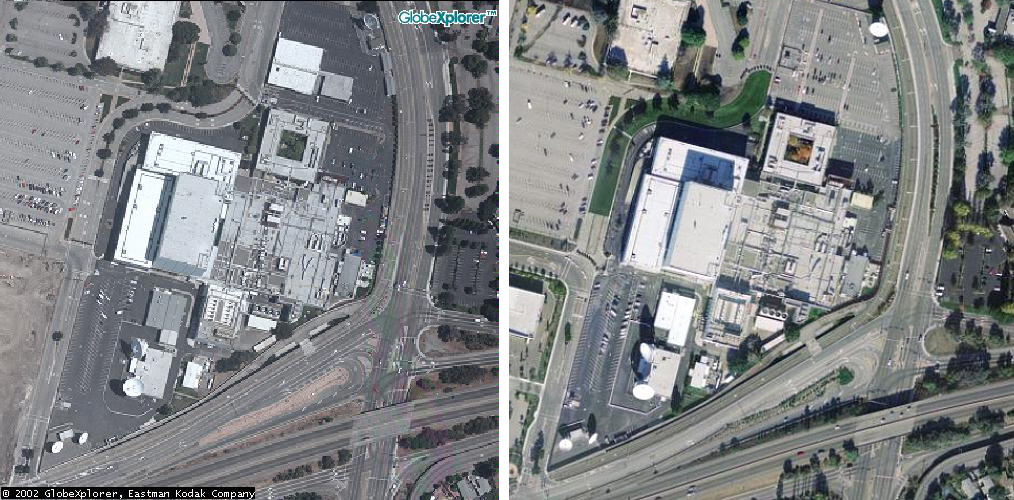
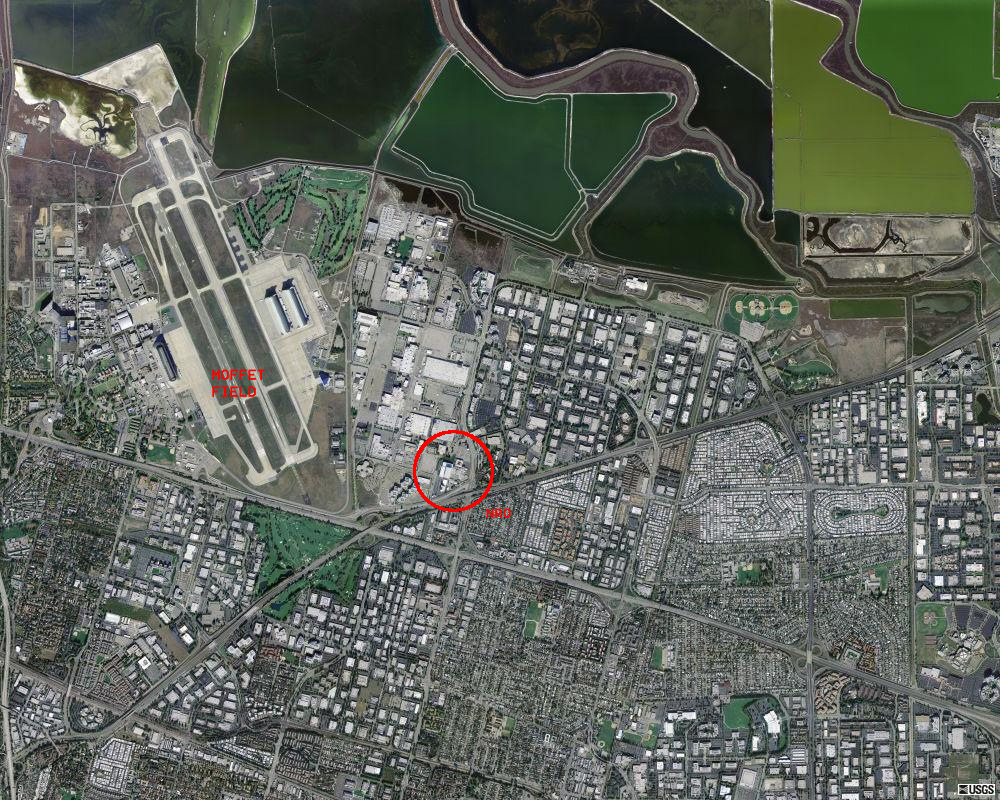
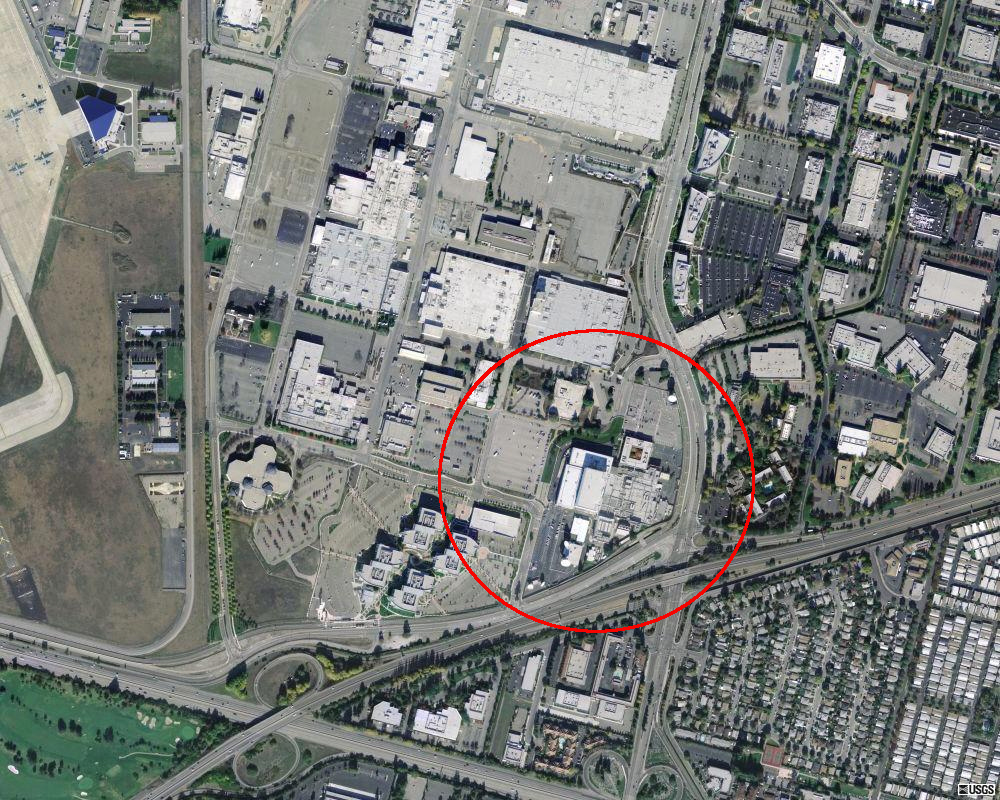
At the southeastern corner of Moffett Field, near the highway, there is a
huge satellite dish, a few smaller ones, and a windowless sky-blue
building. Pretty much everyone who lives in the area knows about this
spot. The original purpose of this installation was to control NRO
spy satellites, but I'm not sure if this is still their mission. The
huge dish has a spinning nose and, based on my conversations with some satellite
engineers about this, is used for range-finding of satellites. Everything
is controlled from the sky-blue box, which is operated by Lockheed-Martin.
National Reconnaissance Office Headquarters:
http://cryptome.org/eyeball/nrobig/nrobig-eyeball.htm
National Reconnaissance Office website:
http://www.nro.gov
|